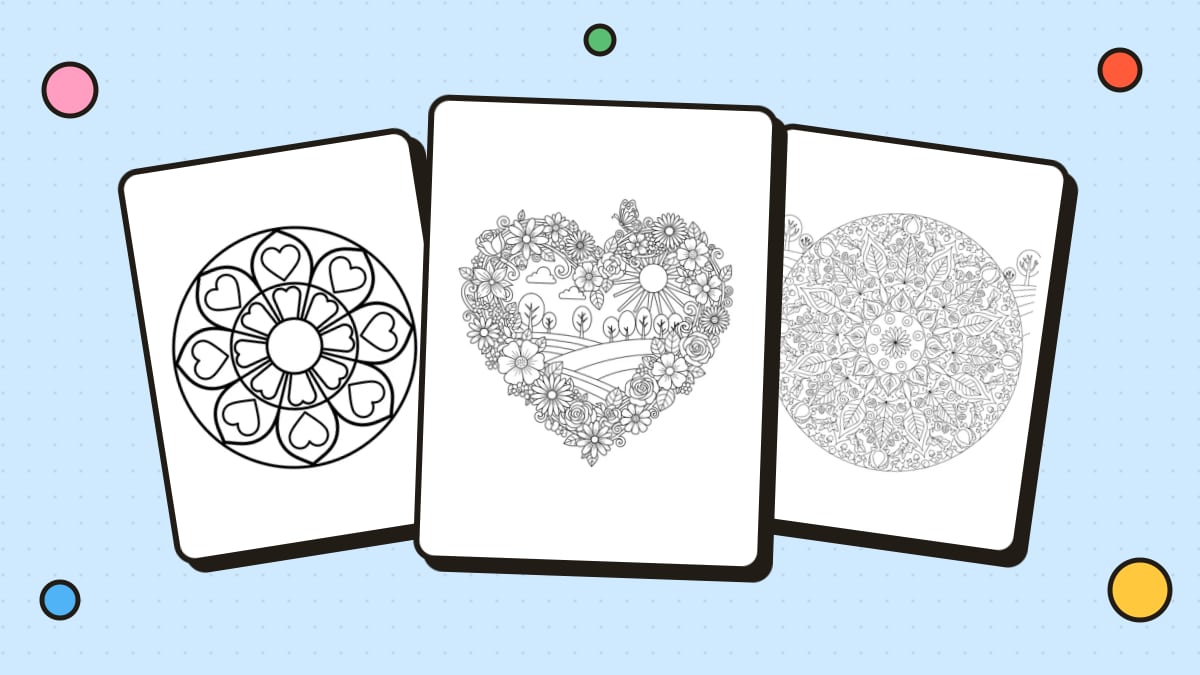
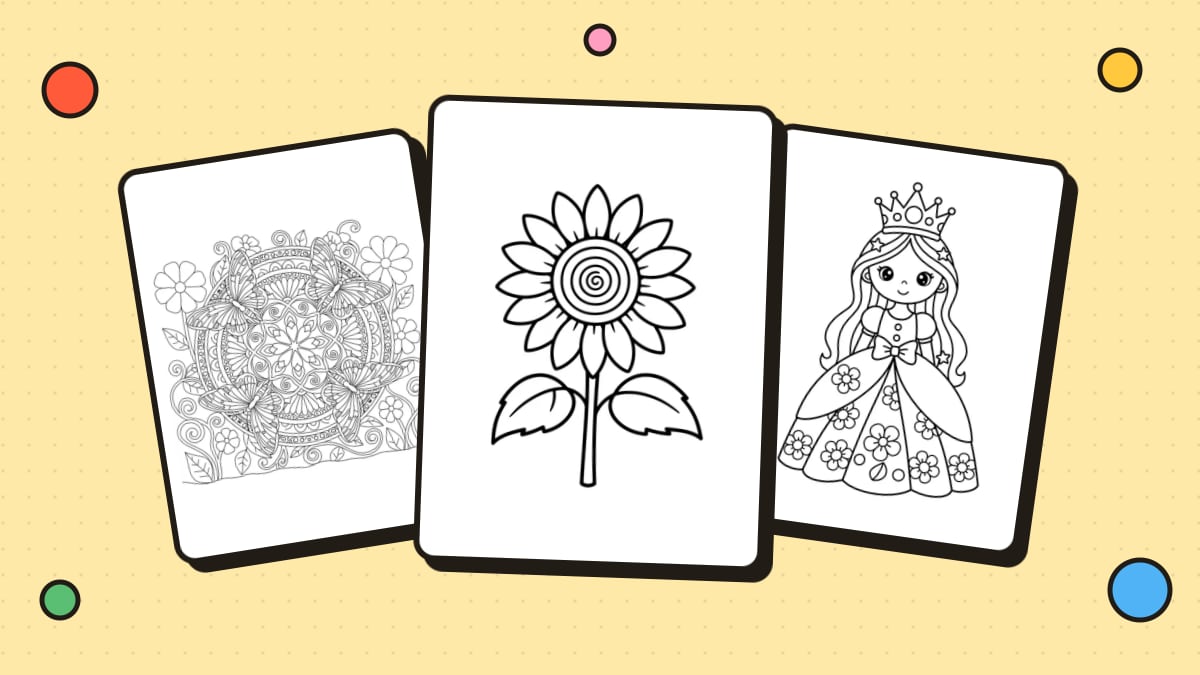
A mandala is a circular design built from shapes and patterns that repeat outward from a center point. The word comes from Sanskrit, an ancient language of India, and means "circle". Mandalas began as sacred art in Hindu and Buddhist traditions, and today people around the world also draw and color them as a calm, focused activity.
This guide covers where mandalas come from, what their parts are often said to represent, and how to color one, whether you're a beginner or have filled a dozen coloring books.
- In Hinduism and Buddhism, mandalas are used as spiritual and ritual symbols. They can represent the universe, a sacred space, or a path toward inner understanding, and are used in meditation and ceremonies.
- Tibetan sand mandalas are some of the best known. Monks create detailed designs grain by grain from colored sand over days or weeks, then sweep them away, a reminder that nothing lasts forever.
- Circular designs appear in many cultures: rose windows in Gothic cathedrals, Islamic geometric patterns, and Indigenous art from many regions all use circles and radial patterns, though each has its own meaning and history and isn't the same as a mandala.
- In the 20th century, psychologist Carl Jung drew mandalas himself and wrote that they could reflect a person's inner state. That idea helped popularize mandala drawing and coloring in the West.
Because mandalas have religious meaning for many people, it's respectful to know their background, even if you're coloring one simply to relax.
Traditional mandalas vary widely, but many share a few elements:
| Part | What it often represents |
|---|
| Center point (bindu) | The starting point, unity or focus |
| Circles | Wholeness, cycles, the universe |
| Squares with gates | A sacred space, often a palace with four entrances |
| Lotus petals | Purity and growth |
| Triangles | Movement or energy (direction matters in some traditions) |
| Outer ring | A protective boundary |
Coloring-book mandalas usually keep the circular, symmetrical structure but drop the specific symbols, so the meaning becomes whatever you bring to it.
Different traditions assign different meanings, and there's no single system. In popular modern use, you'll often see:
| Color | Commonly associated with |
|---|
| Red | Energy, strength, passion |
| Orange | Creativity, warmth |
| Yellow | Joy, learning |
| Green | Nature, balance, growth |
| Blue | Calm, peace |
| Purple | Imagination, spirituality |
| Pink | Love, gentleness |
| White | Clarity, peace |
| Black | Mystery, depth |
Treat these as ideas, not rules. Choose colors you enjoy.
- Pick a palette first. Three to five colors that go together look calmer than every color in the box. Try colors next to each other on the wheel, or a pair of complementary colors (see our color mixing chart).
- Start at the center and work outward ring by ring, or start at the outside and work in. Either way, finish one ring before moving on.
- Repeat colors by ring. Using the same color for each petal in a ring keeps the symmetry.
- Use light-to-dark shading. Make petals darker at the base and lighter at the tips for a 3D effect.
- Leave some areas white. White space keeps a detailed mandala from feeling crowded.
- Go slowly. The point is focus, not speed.
More tips are in our guides to coloring techniques and how to color with colored pencils.
Many adults color mandalas to unwind. The repetition and symmetry give your mind something simple to focus on. Our article on coloring therapy explains what's known about coloring and stress, and what isn't.