With their permanent smiles and frilly pink gills, axolotls look like cartoon characters. But these little amphibians are also one of science's most fascinating animals. Here are 25 axolotl facts for kids, students and anyone who loves strange and wonderful creatures.
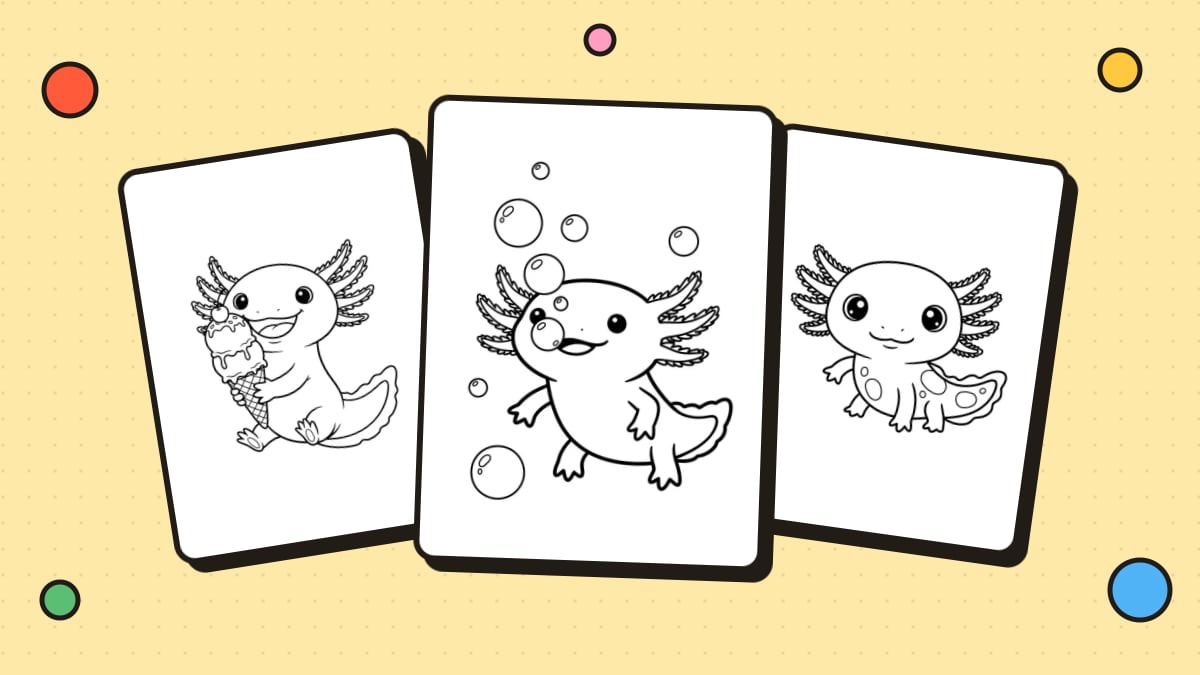
After reading, print a free axolotl coloring page and see if you can color one in its real colors.
What is an axolotl?
- Axolotls are salamanders, a type of amphibian, related to frogs and newts. They're not fish, even though one nickname is the "Mexican walking fish."
- Their scientific name is Ambystoma mexicanum.
- The name "axolotl" comes from Nahuatl, the language of the Aztecs. It's often linked to Xolotl, an Aztec god, and atl, the word for water.
- They're usually about 9 inches (23 cm) long as adults, although some grow longer.
They never really grow up
- Axolotls keep their baby features for life. Most salamanders start in water with gills and then change into land-dwelling adults. Axolotls usually skip that change and stay aquatic, keeping their gills and tail fin. This is called neoteny.
- They can still reproduce while looking like larvae.
- In rare cases, axolotls can transform into a land-dwelling form, but it's unusual and can shorten their lives.
Superpowers: regeneration
- Axolotls can regrow lost limbs, and the new limb comes back complete with bones, muscles and nerves.
- They can also repair other body parts, including parts of their spinal cord, heart, eyes and brain.
- Regrowth doesn't leave scars in the way human healing does.
- Scientists study axolotls to understand regeneration and how it might one day help human medicine.
- Their genome is huge. The axolotl's DNA is roughly ten times larger than the human genome, and it was one of the largest animal genomes ever sequenced.
How axolotls breathe
- Those feathery "horns" are gills. Axolotls have three pairs of external gills that take oxygen from the water.
- They also have lungs and sometimes swim to the surface to gulp air.
- They can absorb some oxygen through their skin, too.
Food and behavior
- Axolotls are carnivores. They eat worms, insect larvae, small crustaceans and small fish.
- They feed by suction. An axolotl opens its mouth quickly and sucks in its prey along with water.
- They have tiny teeth, used for gripping, not chewing.
- They like cool water. Axolotls do best in water around 60 to 64°F (16 to 18°C).
- They can live 10 to 15 years in good care.
Colors
- Wild axolotls are usually dark, brownish or greenish with speckles, which helps them hide on the lake bottom.
- Pink axolotls are called leucistic. They have pale skin, dark eyes and red gills.
- Other colors exist in captivity, including golden albino, white albino and all-dark "melanoid" axolotls.
Where axolotls live and why they need help
- Wild axolotls live in only one place: the lakes and canals of Xochimilco, near Mexico City. They're found nowhere else in the wild.
- They are critically endangered. City growth, pollution and introduced fish have caused wild populations to crash. Conservation groups in Mexico are working to protect their habitat, including the traditional floating farms called chinampas.
Axolotls in culture
Axolotls are a symbol of Mexico City and have appeared on Mexican banknotes. Around the world, their smiling faces have made them hugely popular in art, toys and, of course, coloring pages.
Axolotl activities for kids
- Color an axolotl in each real color: wild-type, pink, gold and melanoid. Print our free axolotl coloring pages.
- Draw an axolotl habitat with water plants, rocks and a muddy lake bottom.
- Make a fact card. Pick your three favorite facts and write them under a drawing.
- Invent an axolotl superhero with regeneration powers, then create your own coloring page with the AI Coloring Page Generator.
Love water animals? Check out our fun facts about sharks and animal coloring pages.
FAQ
Are axolotls fish?
No. Axolotls are amphibians, a type of salamander. They have legs, lungs and gills.
Why do axolotls look like they're smiling?
The shape of their mouth naturally curves upward, giving them a permanent smile.
Can axolotls really regrow their legs?
Yes. Axolotls can regrow complete limbs, as well as parts of their heart, spinal cord, eyes and brain.
Where do axolotls live?
In the wild, only in the lakes and canals of Xochimilco near Mexico City. Most axolotls in the world today live in aquariums and labs.
Can you keep an axolotl as a pet?
In some places, yes, but they need cool, clean water and careful care, and they're illegal to own in some areas, including California. Always check your local laws first.