Sharks are some of the most fascinating and misunderstood animals on the planet. They've been around for hundreds of millions of years, come in every size from pocket-sized to bus-sized, and have senses that seem almost like superpowers. Here are 30 fun facts about sharks to share with curious kids, students or anyone who loves the ocean.
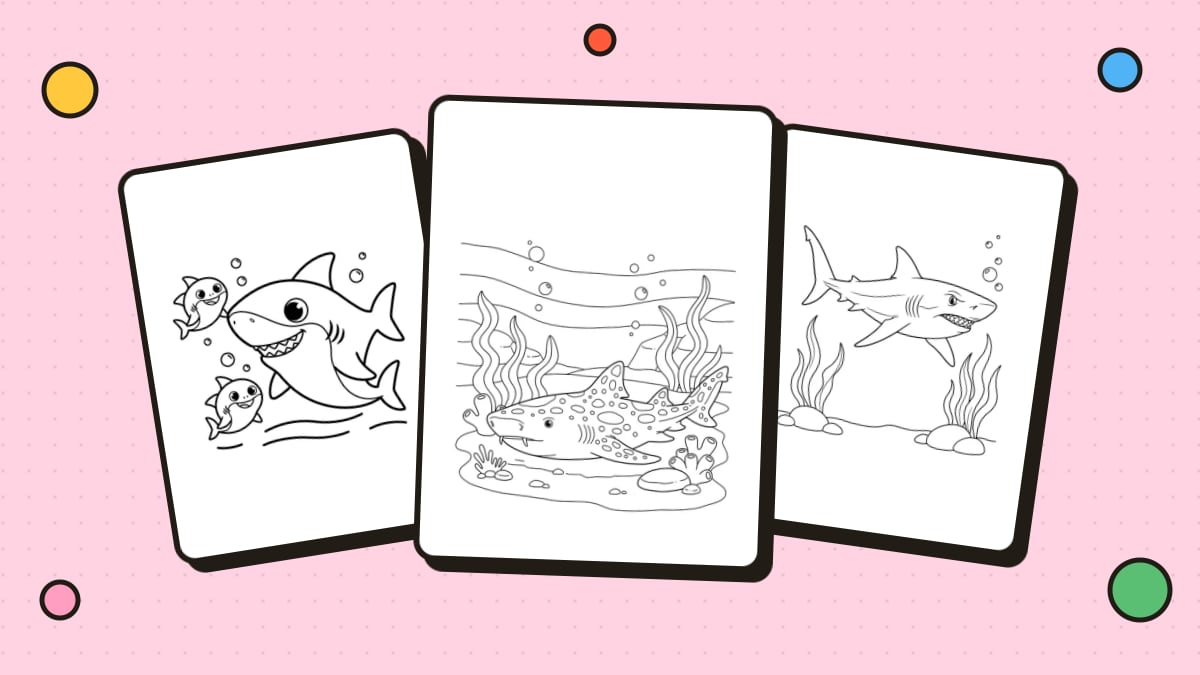
When you're done reading, print a few free shark coloring pages and see how many species you can recognize.
Sharks are ancient
- Sharks are older than trees. The earliest sharks appeared more than 400 million years ago. The first trees came tens of millions of years later.
- They're older than dinosaurs, too. Sharks had already been swimming for about 200 million years when the first dinosaurs appeared.
- Sharks survived several mass extinctions, including the one that wiped out the dinosaurs.
- Megalodon was a giant prehistoric shark. It lived millions of years ago and is thought to have been far bigger than any shark alive today.
Sharks' bodies are amazing
- Sharks have no bones. Their skeletons are made of cartilage, the same flexible material in your nose and ears.
- Shark skin feels like sandpaper. It's covered in tiny tooth-like scales called dermal denticles that help sharks swim smoothly and quietly.
- They don't have a swim bladder. Most fish float using an air-filled swim bladder. Sharks rely on a large, oily liver to help them stay buoyant.
- Many sharks must keep swimming to breathe. Species like the great white need water flowing over their gills. Others, like the nurse shark, can pump water over their gills while resting on the sea floor.
- Sharks keep growing new teeth. Their teeth sit in rows, and when one falls out, another moves forward to replace it. Some sharks go through thousands of teeth in a lifetime.
- Shark teeth come in different shapes. Some are sharp and triangular for cutting, others are flat for crushing shells, and some are needle-like for gripping slippery fish.
Shark senses are like superpowers
- Sharks can sense electricity. Tiny pores on their snouts, called ampullae of Lorenzini, detect the weak electric signals given off by living animals, even ones hiding in the sand.
- They can feel movement in the water. A line of sensors along their sides, called the lateral line, picks up vibrations from swimming animals.
- Sharks have an excellent sense of smell. Some can detect tiny amounts of substances in the water from a long distance away.
- Many sharks see well in dim light. A reflective layer at the back of their eyes helps them see in dark water.
- A hammerhead's wide head helps it hunt. Its eyes are spread far apart and the extra width holds more electrical sensors, which helps it find prey hidden under the sand.
Big sharks, small sharks
- There are more than 500 species of sharks. Scientists still discover new ones.
- The whale shark is the biggest fish in the world. It can grow longer than a school bus.
- The biggest sharks eat the smallest food. Whale sharks and basking sharks are filter feeders that eat plankton and small fish.
- Some sharks are tiny. The dwarf lanternshark is one of the smallest, at about 8 inches (20 cm) long, and it glows in the dark.
- The shortfin mako is the fastest known shark. It can make short bursts of speed that help it catch fast fish like tuna.
Surprising shark behavior
- The Greenland shark may be the longest-living vertebrate. Scientists estimate some live for more than 250 years, and possibly much longer.
- Bull sharks can live in fresh water. They've been found far up rivers, including the Mississippi.
- Some sharks lay eggs. Their egg cases are sometimes called "mermaid's purses" and wash up on beaches.
- Other sharks give birth to live young. Baby sharks are called pups, and they're on their own as soon as they're born.
- Tiger sharks will eat almost anything. Scientists have found all sorts of strange objects in their stomachs.
- Some sharks travel huge distances. Great white sharks have been tracked crossing entire oceans.
- Cookiecutter sharks take round bites. These small sharks bite neat, circular chunks out of much larger animals and then swim away.
Sharks need our help
- Sharks are rarely dangerous to people. Worldwide, there are usually fewer than 100 unprovoked shark bites a year. You're far more likely to be hurt by many everyday things.
- People are a much bigger danger to sharks. Tens of millions of sharks are caught by people every year, and many species are now threatened.
- Sharks keep oceans healthy. As top predators, they help keep other animal populations in balance, which helps coral reefs and sea grass beds thrive.
Shark activities for kids
- Color and label. Print our free shark coloring pages and label each species: great white, hammerhead, whale shark, tiger shark and more.
- Size comparison. Measure out 8 inches (a dwarf lanternshark) and then about 40 feet (a large whale shark) in the hallway or yard.
- Tooth match. Draw different shark tooth shapes and guess what each shark eats.
- Design a new shark. Invent a new species, give it a name and a special skill, then draw it, or describe it in the AI Coloring Page Generator.
Love ocean animals? Explore more animal coloring pages and our axolotl coloring pages.
FAQ
What is the most interesting fact about sharks?
Many people are surprised that sharks are older than trees. Sharks have been around for more than 400 million years.
Do sharks have bones?
No. A shark's skeleton is made of cartilage, which is lighter and more flexible than bone.
What is the biggest shark?
The whale shark is the biggest shark and the biggest fish in the world. Despite its size, it eats mostly tiny plankton.
How many teeth does a shark have?
It depends on the species, but sharks keep replacing their teeth throughout their lives. Some go through thousands of teeth over the years.
Are sharks dangerous to humans?
Very rarely. Most sharks avoid people, and unprovoked bites are uncommon. Sharks have much more to fear from humans than we do from them.